

Floorplans · Adventure Families
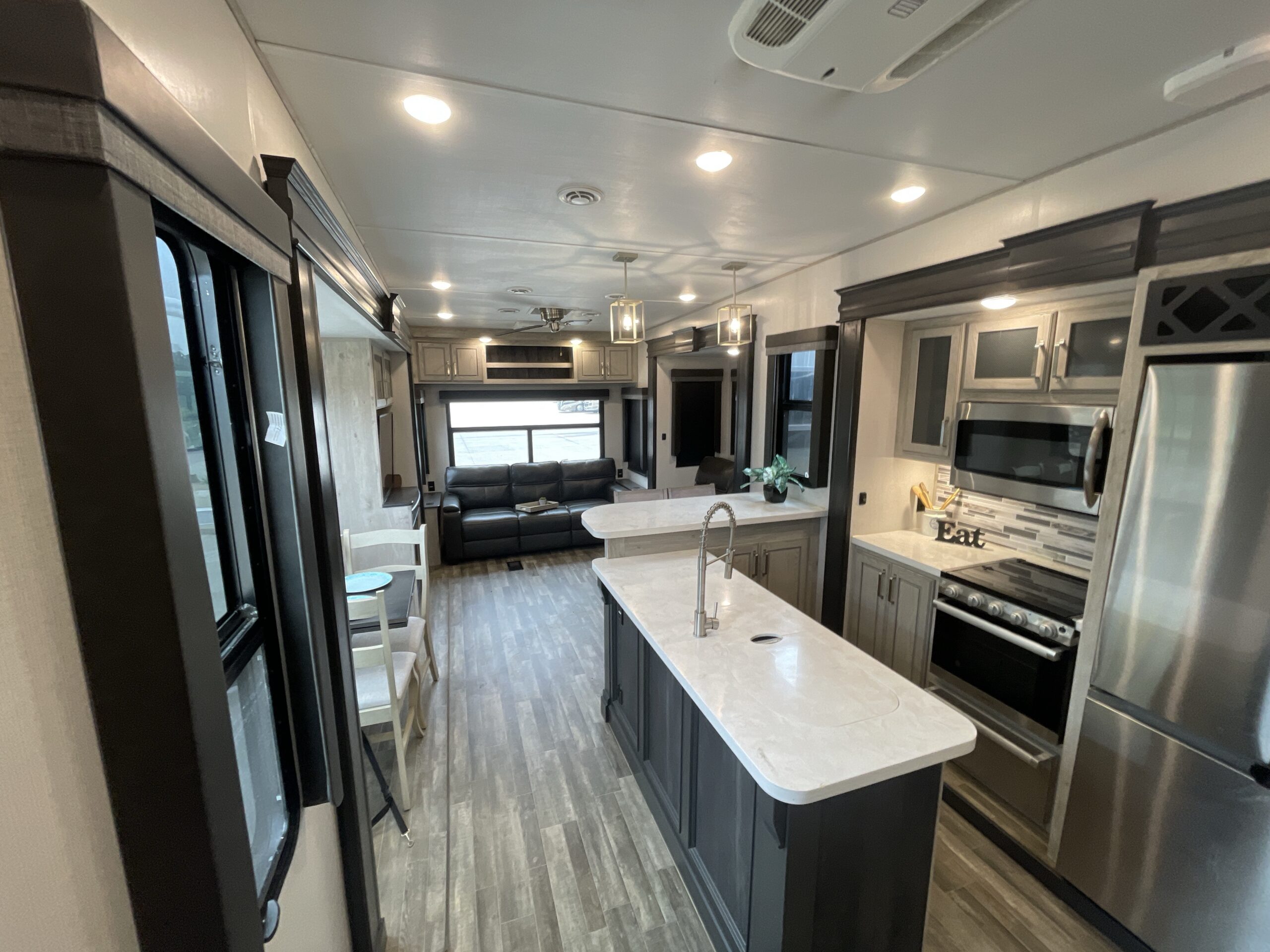
A kitchen island is the feature buyers ask for by name and the feature owners argue about two years later. A dinette is the thing nobody gets excited about and half of them wish they had kept.
This is not a post about which one is better, because that question does not have an answer. It is a post about what each one actually costs you, so you can walk a lot knowing which trade you are willing to make instead of deciding in the four minutes you are standing in a kitchen that smells like new vinyl.
The short answer
- Two of you, and you actually cook. Kitchen island.
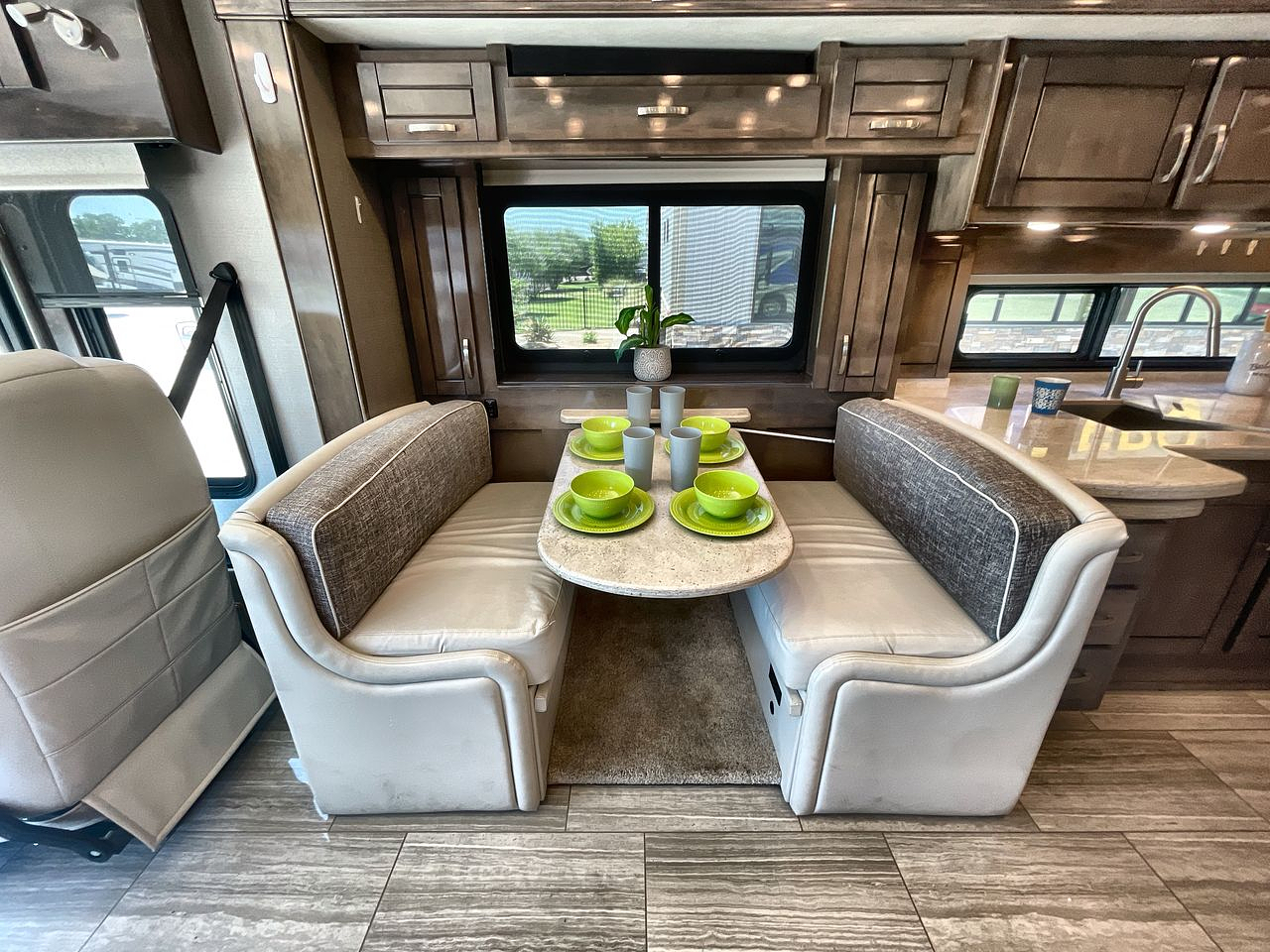
- Four or more, or anyone under fifteen. Booth dinette.
- You want chairs with backs and can live without the spare bed. Free standing table.
If you landed between two of those, the seven trade-offs below are where it actually gets decided.
Start With the One Question That Settles It
Before any of the seven, answer this: how many people sit down in your RV at the same time, on a normal trip, not a holiday one?
If the honest answer is two, a kitchen island is probably the better use of your floor. If it is four or more, and especially if some of them are under fifteen, the dinette is doing more work than you are giving it credit for.
Almost everything below is a variation on that question. The seven trade-offs are where it gets complicated.
Counter Space Against Seats at the Table
This is the trade in its simplest form. A kitchen island gives you a work surface you can stand at from two or three sides. A dinette gives you a place where four people sit down at the same time and look at each other.
Floorplans almost never give you both at full size. When a builder adds an island, the dinette usually shrinks to a two person booth, gets replaced by bar stools along the island, or disappears into a free standing table that has to be moved to open the slide.
Where Everyone Sleeps
Here is the one buyers forget until the first trip with guests. Most booth dinettes drop into a bed. A kitchen island does not turn into anything.
For a family that occasionally travels with a cousin, a grandparent or one more kid than the brochure sleeps, that dinette is a bed you already paid for. If your travel is always the same two or four people, it is a bed you are hauling around for nothing.
Storage, and the Kind You Actually Use
Both layouts store things. They store different things.
A kitchen island stores what you reach for standing up: pots, small appliances, the drawer everything ends up in. Dinette bases store what you reach for once a trip: board games, tools, folding chairs, the bin of things nobody wants to talk about.
Open every dinette base before you decide. Some are deep and usable. Some are mostly wheel well and framing with about a third of the space the lid suggests.

The Walkway a Kitchen Island Eats
A kitchen island eats floor in the middle of the rig, which is exactly where two people need to pass each other while one of them is cooking.
The number that matters is the walkway with the slides pulled in, not out. That is the rig at a fuel stop, at a rest area, and overnight in a parking lot. Plenty of islands that feel generous on the lot turn the kitchen into a one person hallway the moment the slides come in.
Homework, Card Games and Everything That Is Not Dinner
A dinette is used for eating maybe an hour a day. The rest of the time it is a desk, a homework table, a craft station, a card table and the only place in the rig where someone can sit facing another person without both of them being on a couch.
That is the strongest argument for a dinette and it almost never comes up on a lot walkthrough, because nobody shops for the thing they will do on a rainy Tuesday.
Why a Kitchen Island Wins at Hosting
A kitchen island is a party surface. Food goes out on it, people stand around it, and it makes a rig feel like a house rather than a vehicle. If your travel style involves other couples, a site full of friends or grandkids drifting in and out, the island earns its floor space.
If most of your trips are your own family eating dinner together, you are paying real square footage for a surface that gets used the way a counter gets used.
What It Does to Your Next Trade
Layout demand moves. The kitchen island has been the feature buyers ask for by name for several years now, and floorplans that photograph well tend to move faster when it is time to sell or trade.
That is worth something, but not enough to buy a layout you will not use. A dinette floorplan that fits your family is a better purchase than a kitchen island you resent every time the slides come in.

Kitchen Island or Dinette: The 10 Point Comparison
| What you care about | Kitchen island | Booth dinette | Free standing table |
|---|---|---|---|
| Counter space | Most, reachable from multiple sides | Least, one galley run | Least, one galley run |
| Seated capacity | Bar stools at best, often none | Four, sometimes six | Two or four, depending on the set |
| Extra sleeping | None | Converts to a bed in most builds | None |
| Storage type | Daily use, standing height | Bulk, under the seats | None, chairs store nothing |
| Walkway with slides in | Tightest point in the rig | Usually clear | Clear, chairs move |
| Non-meal use | Low, it is a counter | High, desk and homework and games | High, and the chairs go outside |
| Hosting | Strong, people gather at it | Fine, but seats are assigned | Strong, you can add a chair |
| Kids | Nowhere to put them | Contained, facing each other | Loose chairs, less contained |
| Comfort of the seat | Stool, if any | Bench, no back support | Real chair with a back |
| Trade demand | Currently strong | Steady, less fashionable | Strong in higher end units |
5 Signs the Kitchen Island Is Right for You
- You travel as two people and guests are occasional rather than expected
- You cook properly on the road instead of reheating
- You host at the site, and food going out on a surface matters
- Your rig is big enough that the walkway survives the slides coming in
- You are upgrading from something cramped and want it to stop feeling like a vehicle
5 Signs the Dinette Is Right for You
- Four or more people travel with you on an ordinary trip
- Anyone on board does homework, works, or plays games at a table
- You need the extra bed more often than you admit when shopping
- You carry bulky gear that needs somewhere out of sight
- Rainy days are part of your travel, not an exception
The Third Option Nobody Shops For
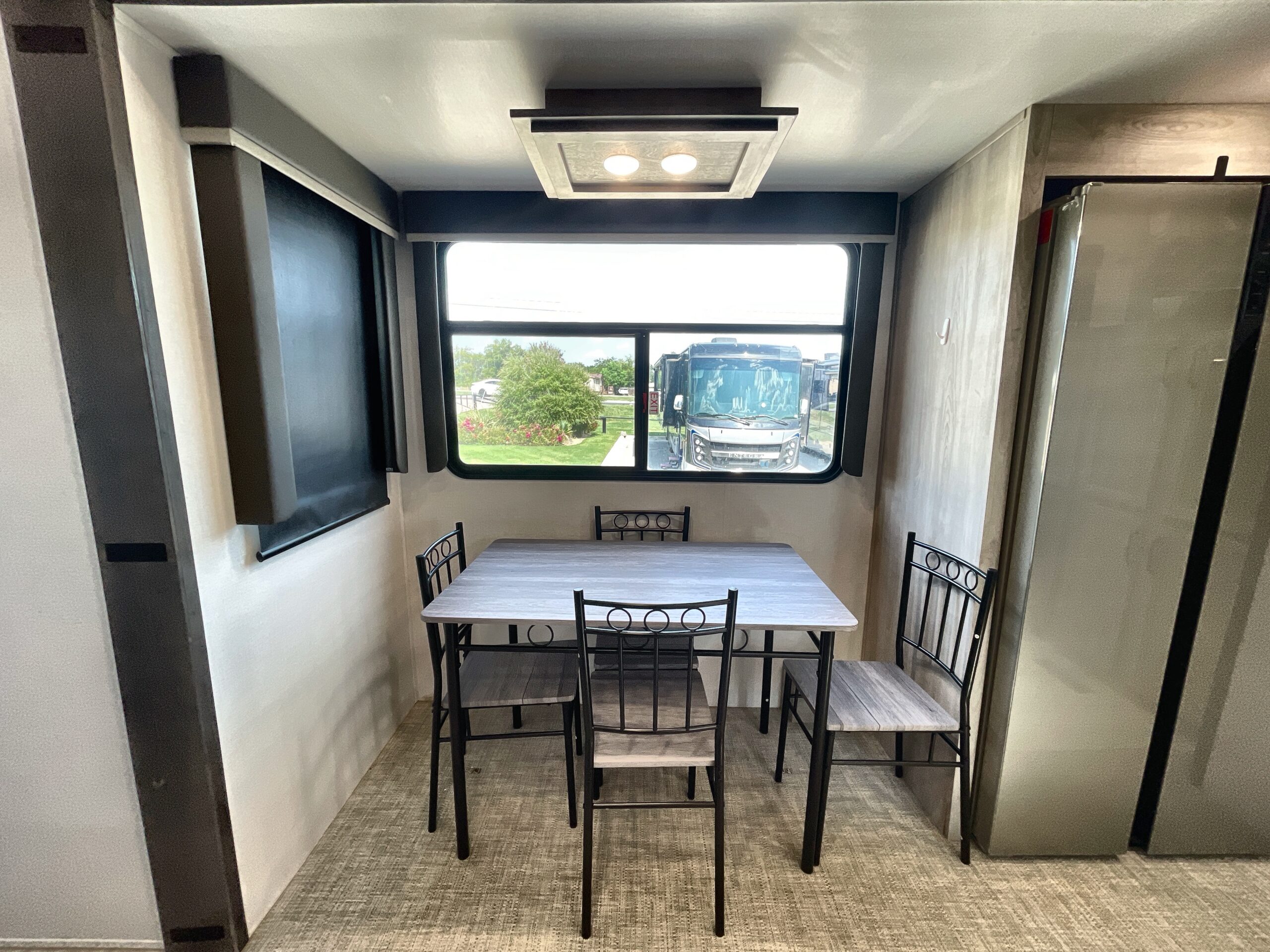
Ask for a kitchen island or a dinette and most people never consider the third layout, which is a free standing table with actual chairs. It is common in higher end fifth wheels and it solves problems both of the other two have.
You get chairs with backs instead of a bench. You can pull one out when you need floor, add one when a guest turns up, or carry two outside to the fire. Nothing about it is fixed, which is the whole point.
The costs are real too. Nothing converts to a bed, there is no under-seat storage, and in a lot of rigs the table has to be moved before a slide will close, which is a small daily chore that gets old.
Two seats or four, and why it matters
Free standing sets come as two seaters and four seaters, and the difference is bigger than one chair. A two seater is a couple’s table that happens to be movable. A four seater is a genuine dinette replacement that seats the same people a booth would, just more comfortably and with less storage. Check which one a unit has, because the floorplan drawing often shows a generic rectangle either way.
What to Check When You Walk the Unit
Six things a photo will not tell you
- Pull the slides in, then walk the kitchen. That is the real width.
- Convert the dinette. Lie on it if you are the one who will sleep there.
- Open every seat base and look past the lid for wheel wells and framing.
- Stand at the island and open the oven, the fridge and the nearest drawer. See what blocks what.
- Sit at the table with someone else and see whether you both fit comfortably or technically.
- If it is a free standing set, count the chairs and check whether the table has to move before the slide will close.
Every RV type is on the 20 acre lot in Cleburne, so you can compare an island floorplan and a dinette floorplan back to back in the same afternoon rather than from two different dealerships on two different weekends. That comparison takes about twenty minutes and it is the only way this decision gets easy.

Where to Look in the Inventory
The kitchen island turns up most often in fifth wheels and larger travel trailers, since it needs floor width to work. Dinettes are close to universal in bunkhouse layouts because the families buying them need the seats.
Two starting points worth browsing: fifth wheel rear living floorplans, where a kitchen island is common, and bunkhouse travel trailers, which is the largest single group on the lot and where the dinette is doing the most work.
Kitchen Island and Dinette FAQ
Can you have a kitchen island and a dinette in the same floorplan?
Yes, in larger fifth wheels and Class A coaches. Below a certain length something gets cut down, usually the dinette to a two person booth or the kitchen island to a narrow peninsula. Measure both rather than trusting the floorplan drawing, which is not to scale as often as you would hope.
Does a kitchen island hurt resale?
Not currently. The kitchen island has been a requested feature for several years and it photographs well, which matters on a listing. The bigger resale factor is condition and how common the floorplan is, not the island itself.
Are dinette beds actually comfortable?
It ranges from genuinely fine to strictly an emergency. The variable is how flush the cushions sit when converted and whether there is a seam under the sleeper’s shoulders. This is worth five minutes of your time on the lot, lying down, regardless of how it looks.
Which is better for full timers?
The longer you stay in a rig the more the non-meal hours matter, which tends to favor a table you can sit at properly. That said, a solo traveler or a couple who cooks seriously often ends up happier with the island. The pattern is that the more people and the more hours, the more the table wins.
Can I change it after I buy?
Removing a free standing table is easy. Swapping a booth dinette for a table and chairs is common and not difficult. Adding or removing a fixed kitchen island is a different job: it is structural, ties into plumbing or wiring in many builds, and is not a modification most owners should plan on. Buy the layout you want.
Compare More. Settle Less.
Walk Both Layouts in One Afternoon
A 20 acre lot, hundreds of used RVs from 90 plus top brands, every RV type represented, and a team that has been helping families find the right RV since 1990.
Tell your RV specialist you are deciding between a kitchen island and a dinette and they will take you to one of each instead of walking you around the lot all day. There is plenty of parking out front, so come say hello.

RV Depot Supercenter
Family owned since 1990Call
(817) 221-0660Hours
