
Pet-Friendly Travelers · National Pet Bird Day
Pet birds are one of the most overlooked travel companions in the RV world. Dogs get the campground meetups and cats get the window perch, but plenty of families pull out of the driveway with a cockatiel, a conure or an entire flock riding along.
It works. It just takes a different plan than the one you would build for a dog. National Pet Bird Day on September 17 is a good excuse to lay that plan out, and September 17 also happens to be Bluebird of Happiness Day, which feels about right for a subject this cheerful and this loud.
Why Pet Birds Need a Different RV Plan Than Dogs and Cats
A dog adjusts to a moving house in about a week. Pet birds are a different animal, literally. They are small, they react to things you cannot see or smell, and they are built to fly away from anything that startles them. All three of those traits turn into design problems inside a box on wheels.
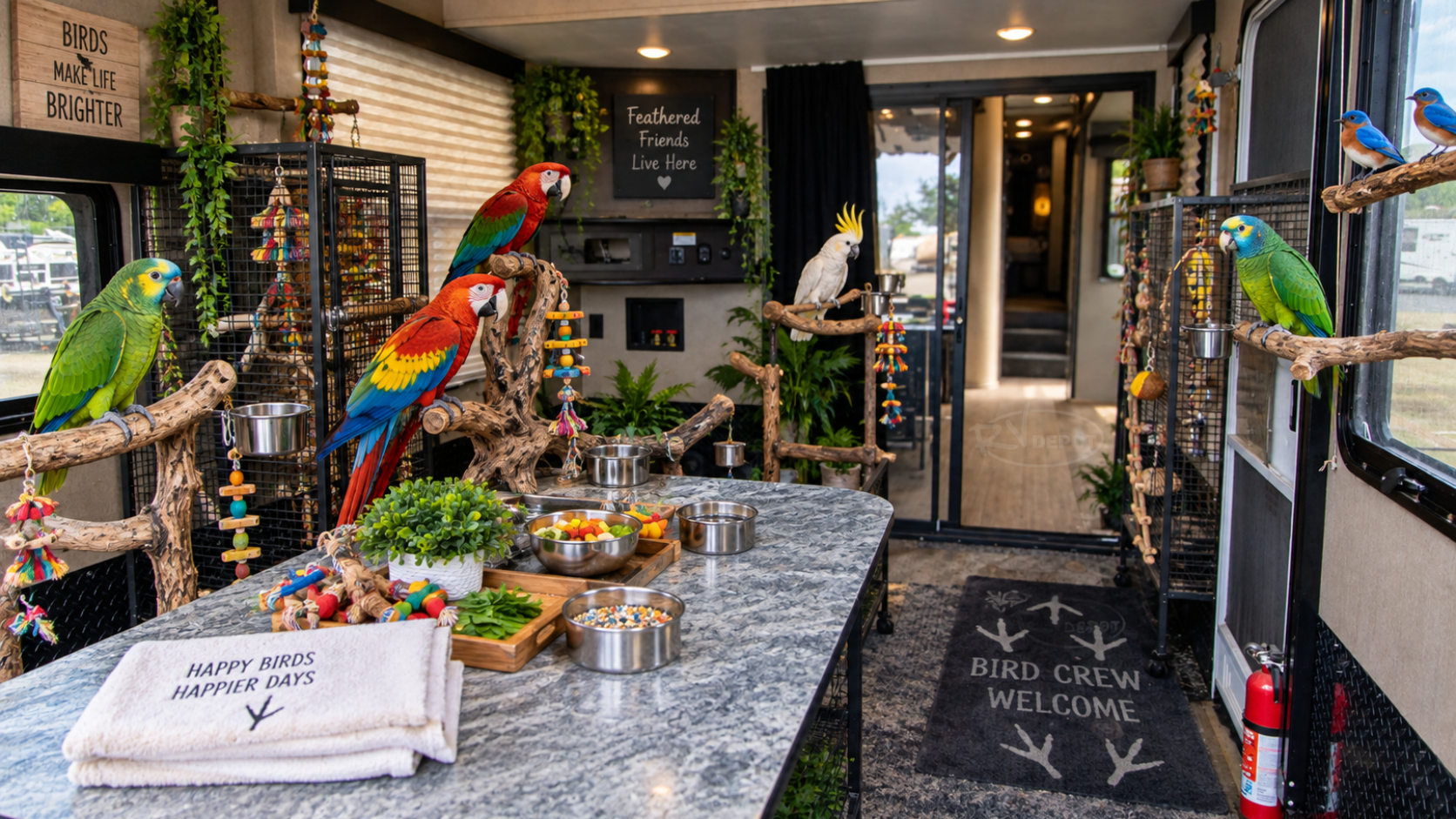
The upside is that an RV is one of the few homes you can genuinely build around an animal. Layouts flex. Storage moves. A toy hauler garage is a large, open, washable space that does not have to hold an ATV, and more than one owner has quietly handed that room over to the parrots.
Everything that follows falls into one of two buckets: the environment you control, and the habits you build. Pet birds need you to get both right.
Temperature Is the First Thing You Solve for Pet Birds
An RV heats up far faster than a house, and it cools down faster too. A rig sitting in a Texas parking lot with the climate control off can climb to dangerous numbers in well under an hour. That is the single biggest risk to pet birds on the road, and it is also the easiest one to plan for.
Most companion species, tropical birds like parrots, conures and cockatiels included, do well in the same 65 to 80 degree range people find comfortable. The bigger danger is speed. A swing of 10 to 15 degrees inside 24 hours can shock a bird’s system and leave it open to respiratory infection, which is why a cage beside a drafty window or under an air conditioning vent is riskier than a room that simply runs a little cool.
Practical version: park in shade when you can, keep a vent fan moving air, and never leave the rig closed up with the climate control off. Your house batteries and your shore power plan matter more than usual here, so it is worth reading up on RV battery maintenance before a long trip.
Protect the Air They Breathe
Birds have respiratory systems that make the old coal mine expression more than a figure of speech. Fumes a person would barely register can be serious for pet birds, and an RV is a small enclosed space where anything airborne concentrates quickly.
Ventilation helps, but the real fix is not introducing the fumes in the first place. The five worst offenders are worth knowing by name, and they are listed further down.
Secure the Cage Before the Wheels Turn
A cage that slides six inches on a hard stop is a cage that can tip. Anchor it to a solid mounting point, not to a cabinet door or a slide-out trim piece. Remove swings and heavy hanging toys for travel days, and secure the food and water dishes so they are not launching across the interior at the first hard brake.
Build a Door Routine and Never Break It
With a dog, a screen door is a convenience. With a flighted bird, the door is the single highest risk point in the entire rig. Campgrounds are full of open doors, kids, deliveries and neighbors who want to say hello.
Pick a rule and make everyone in the family follow it: pet birds are caged or in a carrier any time an exterior door is going to open.
Give Pet Birds a Zone, Not a Corner
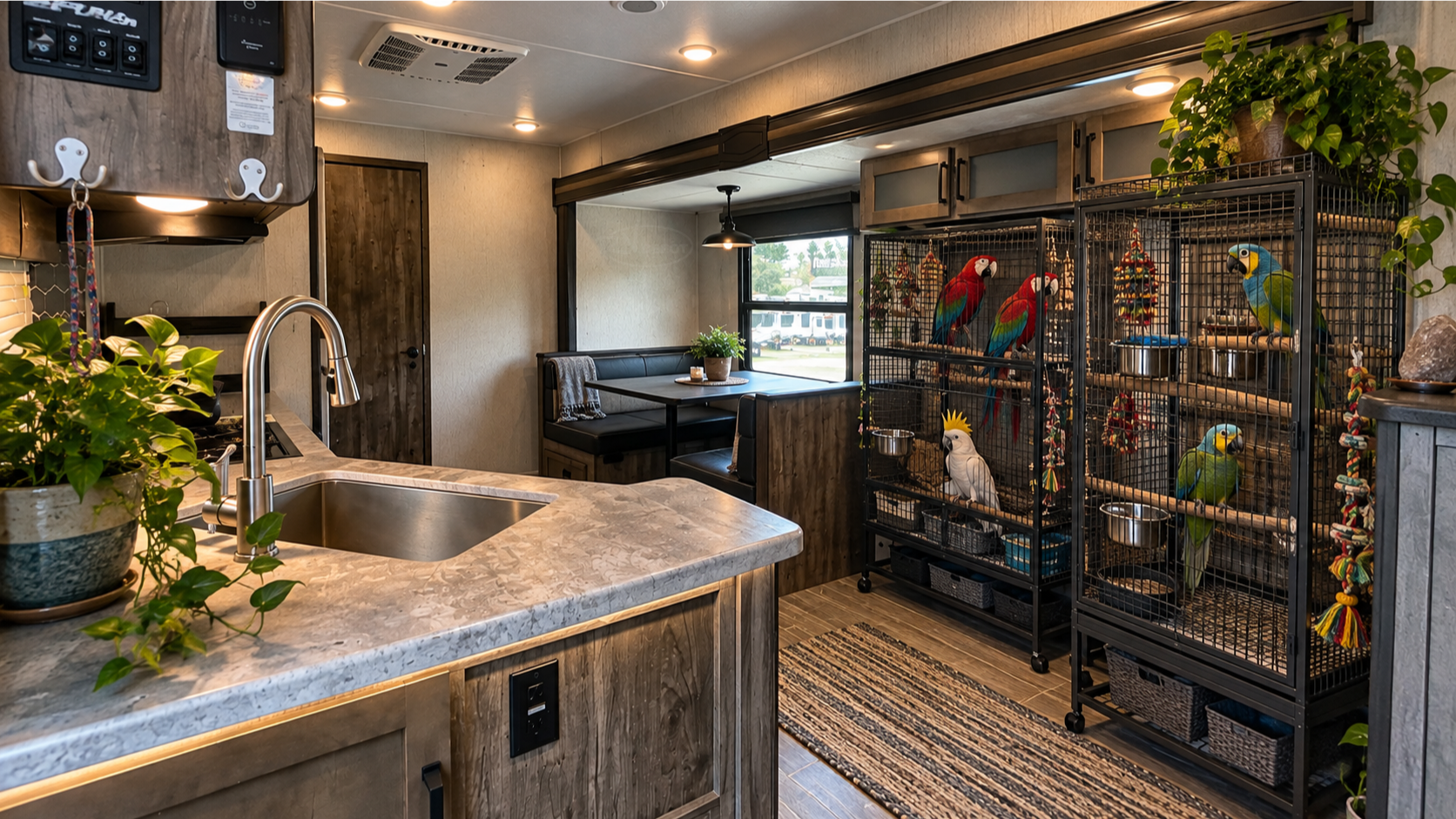
The families who do this well stop thinking of the cage as furniture and start thinking of it as a zone.
What a real bird zone includes
- A secure cage position anchored to structure
- A play stand that sets up outside or in a garage area
- A feeding station that is not competing with your kitchen counter
- Dedicated storage for food, toys and cleaning supplies
This is where floorplan choice does real work, and it is why pet birds belong in the conversation while you are comparing layouts rather than after you have already bought.
Protect Their Sleep
Campgrounds are brighter and noisier at night than most houses. Between security lighting, neighbors arriving late and thin walls, a bird that needs a long solid dark period can end up chronically short on rest.
Most companion species do best with 10 to 12 hours of dark, quiet down time. It does not have to be twelve unbroken hours of unconsciousness, since wild birds wake, shuffle and resettle through the night. What matters is a long stretch away from light and household activity.
Short that night after night and it shows up as behavior. Constant light mimics a long spring day, which can drive hormonal surges, screaming, territorial biting, chronic egg laying and feather destructive habits. For pet birds, a proper cage cover and a position away from the brightest window handles most of it.
Manage Noise and Vibration
Road noise, generator hum and the constant motion of travel are all new inputs. Some pet birds settle into it within a few trips and some never love it. Short shakedown runs before a long haul tell you which kind you have, and they cost you nothing but a weekend.
Plan Food, Water and Cleanup
Fresh food is harder to keep on the road than at home, so think through refrigerator space and how often you will actually restock. Water needs to be secure on travel days and available the rest of the time. Cleanup is constant with pet birds, so easy-clean flooring and a surface you can wipe down matter more than they would for a dog.
Check the Rules Before You Cross a State Line
Requirements involving particular species, health documentation and animal movement vary from state to state, and a few destinations have rules that will surprise you. Do not assume that what is legal at home travels with you.
Campground and resort pet policies vary too, so check both before you book. It also helps to know which kind of property you are booking in the first place, because a resort, a park and a campground are not the same thing and they do not write their pet rules the same way.

The 12 Point Pet Birds RV Setup Checklist
Most of this stays done once you have done it. Run the list before the first trip of the year and any time the rig has been sitting, so nothing catches you out with pet birds already on board.
| Item | What to do |
|---|---|
| 1. Cage anchor | Mounted to structure, not a cabinet door or trim |
| 2. Travel carrier | One per bird, stored where you can reach it fast |
| 3. Climate plan | Shore power, generator or battery capacity to run air conditioning |
| 4. Thermometer | Placed at cage height, not at the ceiling |
| 5. Vent fan | Working, with a plan for air movement when parked |
| 6. Cookware audit | Nonstick removed or replaced |
| 7. Product audit | No aerosols, candles, plug-ins or harsh cleaners aboard |
| 8. Door rule | Written down, agreed to by everyone traveling |
| 9. Cage cover | Blocks campground lighting for a full dark period |
| 10. Food storage | Sealed, pest proof, separate from the human pantry |
| 11. Cleanup kit | Bird safe cleaners and a wipeable floor surface |
| 12. Paperwork | Health records and any documentation your route requires |

5 Hidden Air Quality Risks for Pet Birds in an RV
Pet birds cannot tell you when the air has gone wrong, and by the time there is a visible symptom you are already behind. This is the section to get ahead of.
| Risk | Why it matters in a small space |
|---|---|
| Nonstick cookware | Overheated coatings release fumes considered dangerous to birds, and an RV galley is feet from the cage |
| Aerosols and sprays | Hairspray, air freshener and bug spray all disperse through the whole interior at once |
| Candles and plug-ins | Scented products run continuously in a space with limited air exchange |
| Smoke | Cooking smoke, campfire smoke drifting in and tobacco smoke all linger in soft surfaces |
| Cleaning products | Strong chemical cleaners concentrate fast in a closed rig with the vents shut |
7 Things to Secure Before the RV Moves
- The cage itself, anchored and unable to slide or tip
- Food and water dishes, latched or removed
- Swings, bells and any heavy hanging toy
- Play stands and perches that live outside the cage
- Supply bins, so nothing shifts into the cage on a hard stop
- The cage cover, stowed rather than loose
- The birds themselves, caged or carriered, never loose in a moving rig

Which RV Floorplans Work Best for Pet Birds
There is no single right answer, but a few patterns show up again and again among owners traveling with pet birds.
Toy haulers get mentioned most, because the garage is a large open space with a washable floor and its own climate zone in many builds. Rear living travel trailers give you a wall you can dedicate without eating into the traffic path. Larger fifth wheels tend to offer the most usable wall space and storage. On the motorized side, layouts matter more than class, though it helps to understand the differences between motorhome classes before you start walking through units.
What to look for, whatever the type
- A solid wall or structural point to anchor a cage
- Easy-clean flooring
- Real climate control you can run while parked
- Storage that is not already spoken for
- A cage position out of the path between the door and the rest of the rig
Every RV type is on the lot in Cleburne, which means you can walk a toy hauler, a fifth wheel and a Class C in the same afternoon and see which one your setup actually fits. Our general travel tips cover the ground that applies no matter what you are traveling with.
Pet Birds and RV Travel FAQ
Can pet birds handle RV travel at all?
Many do very well. The variable is the individual bird more than the species. Short shakedown trips before a long haul will tell you quickly whether yours settles in or stays stressed, and it is far better to learn that on a weekend than four states from home.
What temperature is safe inside the RV?
Aim for a stable, comfortable range and avoid fast swings, drafts and direct sun on the cage. A thermometer at cage height is worth more than one anywhere else in the rig. Your avian vet is the right source for a specific number for your species.
Should pet birds ride in a cage or a carrier?
A properly sized, secured travel carrier is generally the safer option for driving. The main cage becomes the home base once you are parked and set up.
Are campgrounds and RV resorts fine with pet birds?
Policies vary widely, and some properties write their pet rules around dogs without considering anything else. Call ahead rather than assuming. Our roundup of Texas luxury RV resorts is a good starting list for properties worth calling.
What about noise complaints?
A vocal parrot carries further at a campground than at home. Site selection helps, morning and evening timing helps, and a cage position away from a shared wall or an open window helps. Most of it comes down to being the neighbor you would want.
Where do I get the rest of my questions answered?
Our team has walked plenty of families through layout decisions with animals in the picture. The frequently asked questions page covers the broader buying and ownership questions, and the service department handles the climate control and vent work that matters most here.
More Choices. Better Adventures.
Come See Which Layout Fits Your Flock
A 20 acre lot, more than 400 used RVs from 90 plus top brands, every RV type represented, and a team that has been helping families find the right RV since 1990.
Tell your RV specialist you are shopping with pet birds in mind and they will take you straight to the layouts worth your time instead of walking you around the lot all afternoon. There is plenty of parking out front, so come say hello.

RV Depot Supercenter
Family owned since 1990Call
(817) 221-0660Hours
