
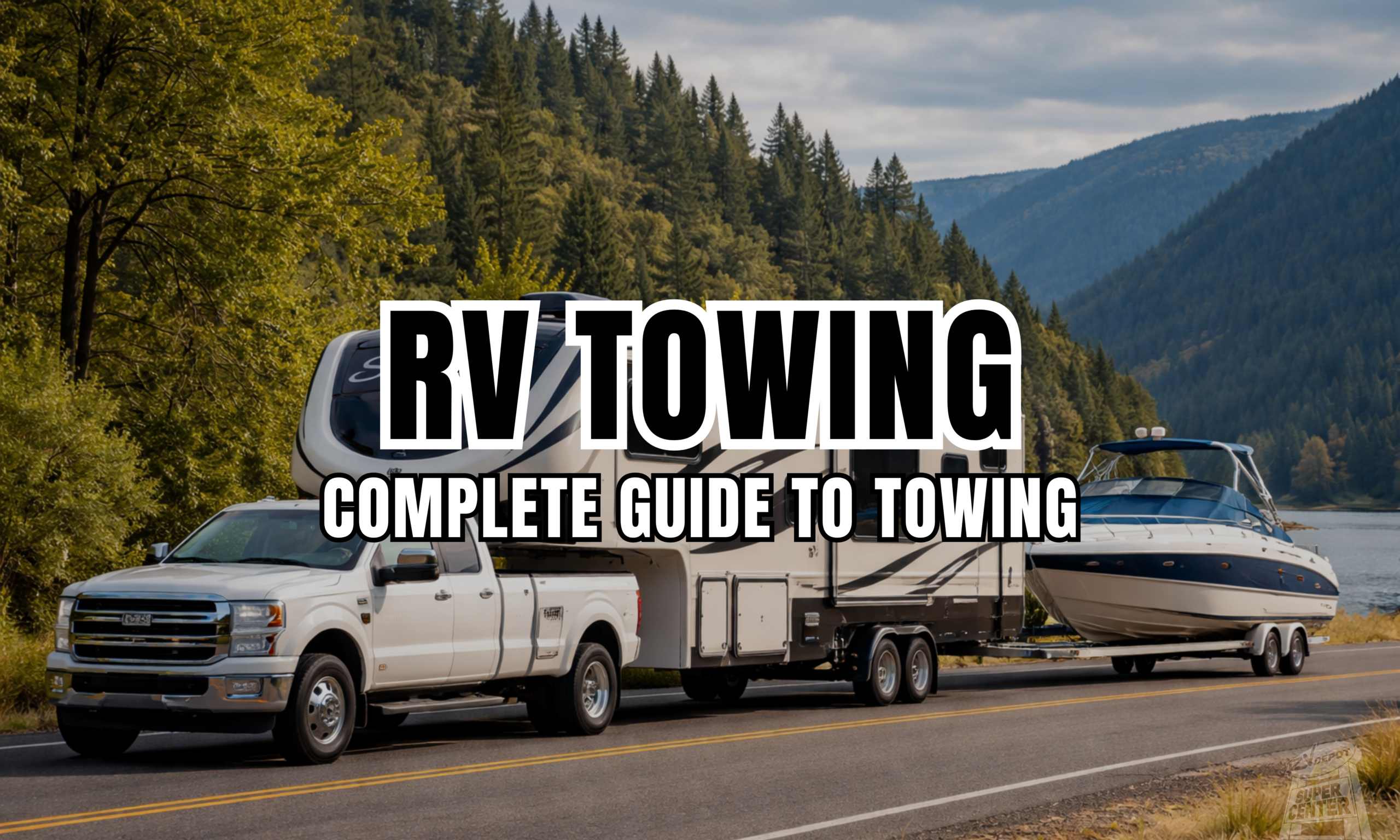
So you want to tow your fifth wheel and your boat on the same trip. It sounds like the ultimate RV adventure — and for many Texas families, it absolutely is. But before you hook up that second trailer and hit the highway, you need to understand one critical reality: RV towing laws are not the same in every state, and what’s perfectly legal at home in Texas can get you forced to unhitch on the side of the road in another state.
This guide breaks down everything you need to know about RV towing for double and triple towing configurations, from terminology and state-by-state legality to weight limits, safety equipment, and the compliance checklist every driver should run before departure.
Understanding the Terminology: Double, Triple, and Quadruple Towing
Before diving into RV towing laws, it helps to get the terminology straight — because the hobbyist community and legal codes often use different language for the same configurations.
Standard towing is simply your truck or motorhome pulling one trailer. No controversy, legal in all 50 states.
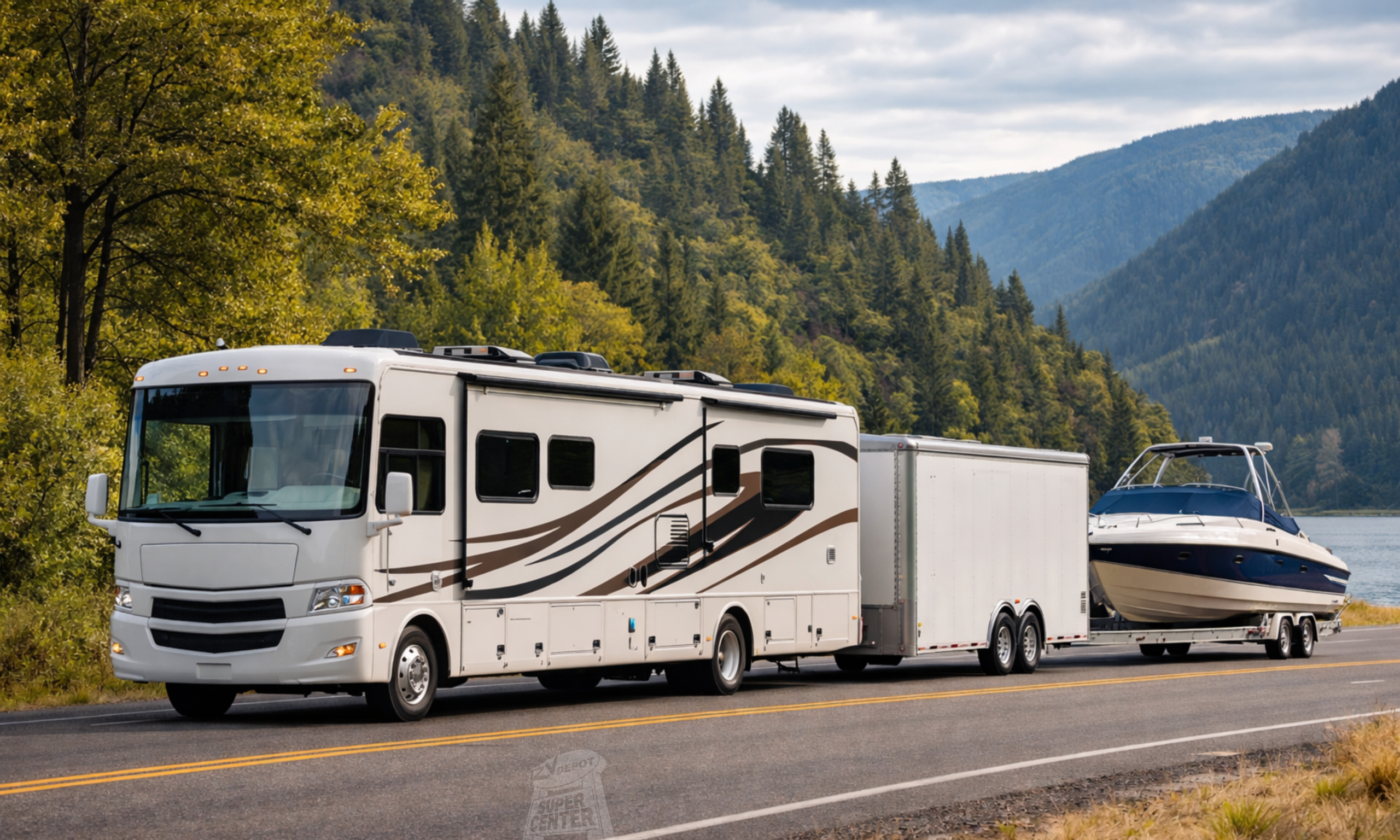
Double towing (also called “tandem towing”) refers to a two-trailer setup: your tow vehicle plus two trailers for a total of three units in line. In the RV world, this is most commonly a pickup truck towing a fifth-wheel RV with a boat trailer hitched behind the fifth wheel. Despite being called “double towing,” there are actually three units in the combination — hence the popular term “triple towing” in RV communities.
Triple towing in the legal sense (four units total) — a truck plus a fifth wheel, a boat, and an additional trailer — is almost universally prohibited for private, non-commercial drivers. Some Western states permit commercial “triple trailer” combinations, but those require a Class A CDL with a “T” endorsement and are restricted to designated trucking routes.
For the purposes of this guide, when we say “triple towing,” we’re using the common RV hobbyist term: one truck pulling two trailers (three units total).
Is Triple Towing Legal? The Big Picture
Here’s the honest answer: it depends entirely on which states your route passes through.
Triple towing (two trailers behind your tow vehicle) is permitted in approximately 28 states, primarily in the Midwest and West. It is explicitly prohibited in several major states including Florida, Pennsylvania, and Washington, and it requires special conditions or permits in states like Virginia and California.
There is no single federal law that governs recreational triple towing. The federal government regulates commercial vehicle combinations on the National Highway Network, but personal RV configurations are almost entirely a matter of state traffic law. That means a setup that’s completely compliant leaving Cleburne, Texas can become illegal the moment you cross into certain neighboring states.
Here’s a quick overview of how key states stack up:
| State | Triple Towing Status | Max Combined Length | Key Requirement |
|---|---|---|---|
| Texas | ✅ Allowed | 65 feet | Recreational 3-vehicle combination rule |
| Colorado | ✅ Allowed | 70 feet | Max 4 units total |
| Michigan | ✅ Allowed | 75 feet | “R” endorsement required |
| Illinois | ✅ Allowed | 60 feet | Fifth-wheel required; RV-specific rule |
| Arizona | ✅ Allowed | 65 feet | “Two-unit combination” language in statute |
| New Jersey | ✅ Allowed | Unspecified | General limit of two towed vehicles |
| Florida | ❌ Prohibited | 65 feet (2-unit) | Noncommercial combos limited to 2 units |
| Washington | ❌ Prohibited | N/A | Unlawful to operate more than 2 vehicles in combination |
| Pennsylvania | ❌ Prohibited | N/A | No more than one towed vehicle |
| Alabama | ❌ Prohibited | N/A | No more than one loaded trailer |
| California | ⚠️ Conditional | 65 feet | Requires Commercial Class A license |
| Virginia | ⚠️ Conditional | Unspecified | Special permit required |
Important: Many states are “Unspecified” — meaning the law is embedded in broader statutes and hasn’t been definitively clarified for recreational RV use. Never assume an unspecified state permits triple towing. Always verify directly with that state’s DOT before your trip.
The Reciprocity Warning: Your Home State Laws Don’t Follow You
This is one of the most important — and most overlooked — aspects of RV towing laws.
Reciprocity does not apply to trailer configurations. Unlike your driver’s license, which is generally honored across state lines, the rules about how many trailers you can tow change completely at each state border.
If it is illegal to tow two trailers in a state you are driving through, law enforcement can require you to unhitch one trailer on the side of the road and leave it. Florida’s Department of Transportation has explicitly confirmed this outcome for violations of their two-unit rule. This isn’t a theoretical risk — it’s a documented enforcement reality.
The practical takeaway: plan your route first, then verify every state on that route before you leave.
Texas Triple Towing Laws: Good News for Lone Star RVers
For Texas residents, the news is favorable. The Texas Department of Motor Vehicles explicitly recognizes “Recreational 3-Vehicle Combinations” and sets a maximum combined length of 65 feet measured from the front bumper of your tow vehicle to the rear-most point of your last trailer.
Texas statute also permits up to three vehicles in a recreational combination, making the classic truck + fifth wheel + boat setup entirely legal within state borders — provided you stay within the 65-foot limit and meet all equipment requirements (lighting, brakes, safety chains, etc.).
If your combined GVWR (Gross Vehicle Weight Rating) across all vehicles exceeds 26,001 pounds, Texas may require a Class A Exempt license. Check with TxDMV or your local DPS office if your rig is in that weight range.
 Weight Distribution and Safety Rules
Even in states where triple towing is legal, the safety requirements are non-negotiable. Getting these right isn’t just about passing inspection — it’s about keeping your family and everyone else on the road safe.
The 80% Towing Capacity Rule
Never tow a combined weight that exceeds 80% of your truck’s maximum rated towing capacity. This is the most important number in triple towing safety.
- Why it exists: The 20% buffer accounts for real-world variables — crosswinds, mountain grades, and emergency braking situations that your truck’s rating doesn’t fully anticipate.
- Mechanical benefit: Operating at 80% capacity significantly reduces strain on your engine, transmission, and brakes, potentially extending the life of those components.
- Example: If your truck is rated to tow 15,000 lbs, keep the combined weight of both trailers at or below 12,000 lbs.
The 60/40 Weight Distribution Rule
For each trailer in your setup, follow the 60/40 rule to prevent dangerous trailer sway (what experienced towers call “the tail wagging the dog”):
- 60% of each trailer’s cargo weight should be loaded in the front half of the trailer, closer to the hitch point.
- 40% should be in the rear half.
This rule applies to both your fifth wheel and your boat/second trailer independently.
Pin Weight and Tongue Weight Targets
| Connection Point | Recommended Weight Percentage |
|---|---|
| Fifth wheel pin weight (on truck bed) | 15%–25% of fifth wheel’s total weight |
| Boat trailer tongue weight (on fifth wheel hitch) | 10%–15% of boat’s total weight |
If the rear of your truck or the back of your fifth wheel is noticeably sagging, you’ve transferred too much weight away from your steering axle. A sagging rear means reduced steering control and significantly increased jackknife risk.
Watch Your Payload — Not Just Your Towing Capacity
Many drivers focus on towing capacity and overlook payload capacity — the amount of weight the truck can actually carry in its bed and cab. The heavy pin weight of a loaded fifth wheel often consumes most or all of your truck’s available payload before you ever hook up the second trailer. Know both numbers before you load.
Equipment Requirements
Meeting state equipment requirements isn’t optional — it’s a legal condition of triple towing in every state that permits it. Here’s what you need:
The Second Hitch
The hitch connecting your second trailer to the back of your fifth wheel must be:
- Frame-mounted — bolted to the structural frame of the fifth wheel, not to the bumper or subframe
- Properly rated for the loaded weight of your second trailer
- Installed by a qualified technician who can certify the rating
Michigan’s detailed RV-specific rules explicitly require frame attachment for the second hitch. This isn’t just Michigan being strict — it’s the engineering standard for any safe multi-trailer setup.
Brakes and Breakaway Systems
Most states require the second trailer to have independent trailer brakes if it exceeds a certain weight threshold, commonly 3,000–4,500 lbs. Even if your second trailer falls below that threshold in a particular state, equip it with functional brakes and a breakaway switch anyway. This improves stopping distance dramatically and significantly reduces your liability exposure if you’re ever involved in a crash.
Lighting
Your final trailer must have fully functional:
- Tail lights
- Brake lights
- Turn signals
- License plate lighting
- Side marker lights (if required by weight/length)
Many triple towers add a wireless backup camera mounted to the rear of the last trailer. In most states, you are legally required to have mirrors that allow you to see the full length of your rig — and a wireless camera is the most practical way to meet that requirement with a three-unit combination.
Safety Chains
Properly rated safety chains are required at both connection points — between your truck and fifth wheel, and between your fifth wheel and second trailer. Michigan’s rules specify how chains must be attached; follow those specifications as your baseline even if your state is less detailed.
Licensing: Don’t Assume You’re Exempt
A common misconception among RVers is that recreational travel automatically exempts you from special licensing requirements. That is not correct.
The Federal Motor Carrier Safety Administration has explicitly confirmed that states may require a CDL even for recreational, non-business RV operation. Each state sets its own rules, and they vary significantly:
- Michigan requires a specific “R” (Recreational Double) endorsement to legally operate a recreational double. A CDL Group A with “T” endorsement can substitute.
- California states that no passenger vehicle, pickup truck, or RV may tow more than one other vehicle without a Commercial Class A license with the proper endorsement. For most recreational RVers, this makes California a practical no-go for triple towing.
- Texas may require a Class A Exempt license if the combined GVWR of all vehicles exceeds 26,001 lbs.
Before your trip, verify licensing requirements for every state on your route — not just your home state.
Your Pre-Trip Triple Towing Checklist
Use this checklist before every triple-tow departure:
Measurements and Weights
- Measure and record total combined length (front bumper to rear-most point)
- Confirm combined trailer weight is at or below 80% of truck’s towing capacity
- Verify pin weight is 15%–25% of fifth wheel total weight
- Verify tongue weight of second trailer is 10%–15% of its total weight
- Check that cargo follows the 60/40 front-to-rear distribution in each trailer
- Confirm you have not exceeded truck’s payload capacity
Equipment
- Second hitch is frame-mounted and properly rated
- Both trailers have functioning lights (tail, brake, turn, marker)
- License plate is illuminated on final trailer
- Brakes function on first trailer; brakes functional on second trailer (highly recommended)
- Breakaway switch functional on both trailers
- Safety chains properly attached at both connection points
- Mirrors or wireless camera provide full rear visibility
- All tire pressures correct for loaded weights
Paperwork and Licensing
- Registration and title/ownership documents for each trailer and boat
- Driver license class and endorsements verified for all states on route
- Insurance coverage confirmed in writing for two-trailer configuration
- Printed or downloaded copies of key state statutes for route states
Route Planning
- State-by-state route sheet listing max units allowed and max combined length
- All route states confirmed as triple-tow legal (not just home state)
- Any required permits obtained for overlength or out-of-state travel
- Fuel stops and turnaround points planned (backing two trailers is extremely difficult — plan to avoid it)
Common Triple Towing Mistakes to Avoid
Assuming legality crosses state lines. It doesn’t. Plan your route state by state.
Confusing towing capacity with payload capacity. You can hit your payload limit long before you reach your towing limit.
Using a bumper-mounted second hitch. This is an equipment failure waiting to happen and is specifically prohibited in states with detailed RV towing rules.
Skipping brakes on the second trailer because it’s “under the limit.” Every extra trailer increases stopping distance. Brakes on the second trailer are always the right call.
Not measuring your total length before departure. Even in states that allow triple towing, exceeding the length limit is a separate violation. Don’t assume your rig is within limits without measuring.
Not checking laws before each trip. RV towing laws change. What was true two years ago may not be true today. Re-verify before every major trip.
How RV Depot Supercenter Can Help
Planning a triple-tow setup is a serious undertaking — and having the right RV makes all the difference. At RV Depot Supercenter in Cleburne, Texas, our team understands multi-trailer configurations because many of us live and travel with rigs just like yours.
We carry an extensive inventory of 400+ new and used fifth wheels, travel trailers, and toy haulers across 20+ acres, including models specifically suited to triple-tow setups — built with the structural integrity and properly rated rear hitch receivers that safe double towing demands. Our knowledgeable staff can walk you through weight ratings, hitch compatibility, and what to look for when selecting a fifth wheel you plan to use as the middle unit in a three-vehicle combination.
Whether you’re a full-time RV traveler or a weekend warrior who wants to bring the boat and the camper on the same trip, we’re here to help you find the right setup and hit the road with confidence.
Stop by our Cleburne location or call us at to talk with a team member about your towing needs. You can also browse our current fifth wheel inventory at rvdepot.us
And if you’re looking for a community of fellow triple-tow enthusiasts who share routes, tips, and real-world experience, join the conversation in the RV Depot Facebook community group — it’s a great place to ask questions from people who’ve already made the trip you’re planning.
The information in this guide is based on publicly available state statutes and DOT publications and is current as of the publication date. RV towing laws change, and this article does not constitute legal advice. Always verify regulations directly with each state’s Department of Transportation or a qualified attorney before your trip.
